
Not Just Flash Cards: The Magic of 3-Part Vocabulary Cards
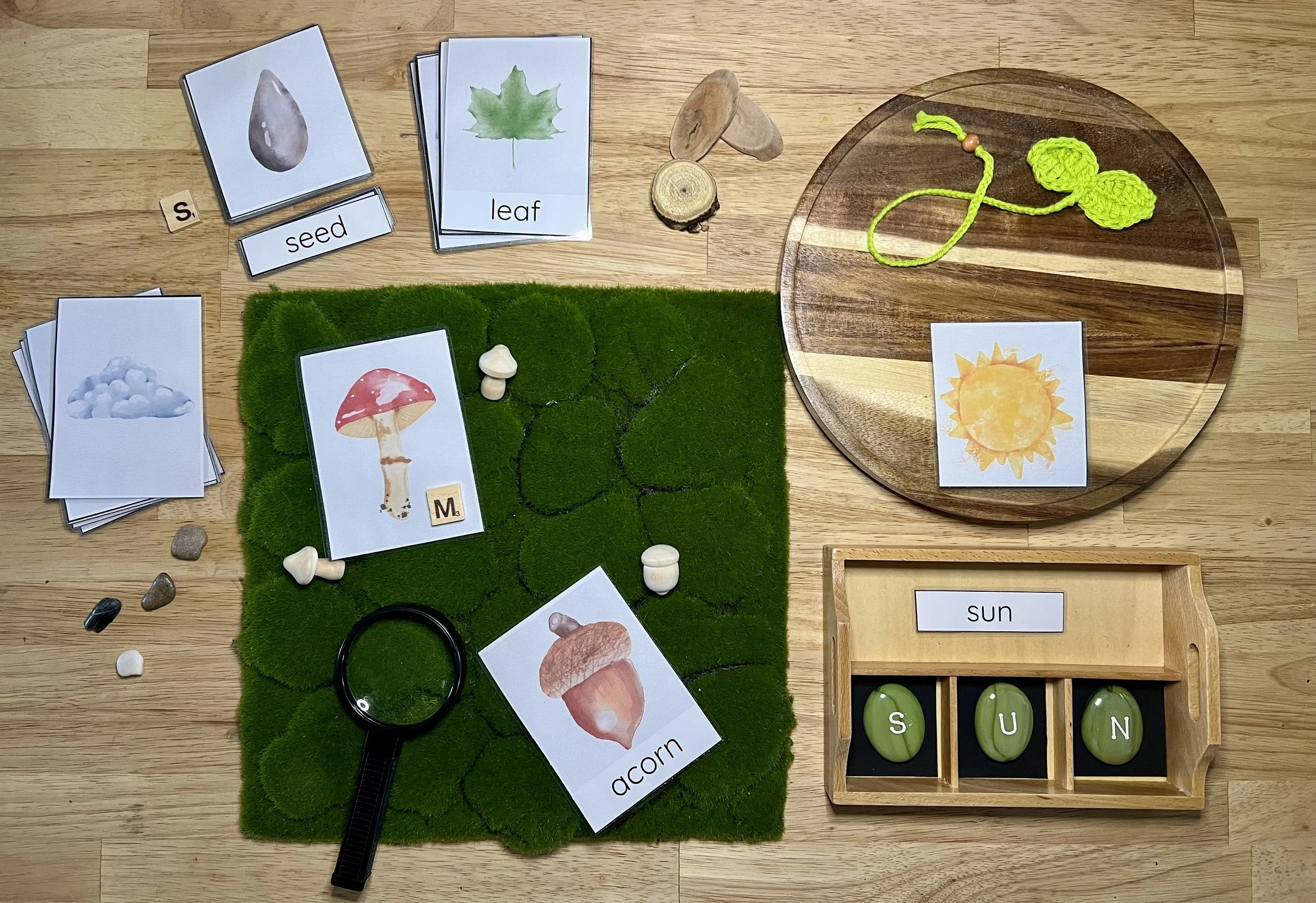
Nature 3-Part Vocabulary Cards
🌱 Pictures on Cards… What’s the Big Deal?
You’ve probably seen picture cards used in early learning before. Some people even say, “Aren’t those just flashcards? Haven’t flashcards been proven to be ineffective?”
FALSE.
Vocabulary cards — especially 3-part cards — go far beyond simple memorization. They open the door to rich, open-ended learning experiences that help young children grow their oral language, strengthen speech sounds, and begin their early literacy journey with joy and curiosity.
Part 1: Image-Only Cards — Building Language Foundations
These cards are wonderful for children who are just beginning to expand their vocabulary or strengthen their speech sounds.
Adding new words (and the matching images) to a child’s background knowledge helps them form more advanced sentences, express more complex ideas, and better understand the world around them.
Remember our conversation about balance (see my earlier post, “Balance”)? I used to believe that the images children worked with should only be real-world photos. Then one year, my class and I did an art study — exploring photography, comic books, abstract art, sculpture, and more.
Through that study, I saw how important it is for children to experience many versions of an object to build truly flexible, well-rounded background knowledge.
For example, one child in my class recognized every animal in a cartoon zoo book, but when we looked at a nonfiction photo book, he became frustrated — he was sure the realistic elephant wasn’t an elephant at all! It was such an eye-opening moment. I realized that children need to see and experience the same concept across multiple representations to really understand it.
Part 2: Image + Word Cards — Making the Connection
These combine images with printed words underneath. They encourage children to begin noticing letters, patterns, and word shapes — and to connect spoken and written language naturally.
This stage supports early print awareness and lays the foundation for reading readiness.
Part 3: Image + Word Cut-Apart Cards — Early Reading in Action
These look just like the image + word cards, except the word is cut apart from the image.
This small change creates a big challenge! Children must focus on the letters, sounds, and word structure — and then match each word to its correct image. It’s a gentle, play-based step into early reading skills.
Endless Ways to Play and Learn
Outside of the main learning benefits, vocabulary cards can be used in countless open-ended ways across multiple ages and stages. Try using them for:
Memory or matching games
Bingo
Scavenger hunts
“Write the room” activities
Storytelling or oral language prompts
And so much more! Children’s imaginations will find new ways to play each time.
Bringing It All Together
These cards are so much more than a “teaching tool.” They invite children to observe, describe, connect, and wonder — all while growing vital language and literacy skills.
🌿 Explore our Nature Vocabulary Cards here and see how many meaningful, playful learning moments they can inspire in your home or classroom.
